Approval queue.

Your GHL automations aren't broken. Your trigger conditions are fighting each other. This is the most common automation problem I see in home service accounts — and it almost never gets diagnosed correctly. The symptom looks like a broken workflow: leads fall through, follow-up sequences fire twice, or nothing fires at all. So the instinct is to rebuild the automation from scratch. New workflow, same chaos. Here's what's actually happening: you've got multiple workflows listening for overlapping triggers. A contact hits "Lead Created" in Workflow A and "Tag Added: New Lead" in Workflow B simultaneously. Both fire. Now you have two follow-up sequences running on the same contact, your pipeline stage gets updated twice, and if either workflow has a "remove tag" step, it quietly kills the other one mid-sequence. The fix isn't rebuilding. It's auditing your trigger logic. Pull up every active workflow and map what tag, pipeline stage, or form submission kicks it off. Look for overlaps. Then add filter conditions — not just triggers — so each workflow has a clear lane. "Tag Added: New Lead" AND "Pipeline Stage is NOT Booked" means that workflow only runs for contacts that actually need it. One more thing: check your enrollment settings. "Allow re-enrollment" turned on with a broad trigger is usually what turns a single contact into a 47-email nightmare. If your GHL automations feel unpredictable, reply with what you're running — HVAC, plumbing, roofing, whatever — and I'll tell you the specific overlap patterns to look for first. #GoHighLevel #HomeServiceMarketing #MarketingAutomation
Your GHL automations running quietly in the background isn't a sign they're working. It's usually a sign no one's checked them in months. The myth: once an automation is built and tested, it runs itself. Set the trigger, write the sequence, publish it, done. This is what most agencies tell you — implicitly, by never mentioning maintenance again after onboarding. Here's what actually happens inside a 'running' automation after 90 days: contact tags drift because your intake form changed. A follow-up step references a service you no longer offer. A webhook to your scheduling tool breaks silently after an API update. Emails hit spam because a sending domain needs re-authentication. Nobody gets an alert. The automation still shows 'active.' For home service businesses, this has a real cost. A roofing company I worked with had a 5-step estimate follow-up sequence that looked fine on the surface. Step 3 was routing to a pipeline stage that had been renamed 6 months earlier. Every lead after that point was falling into a dead branch — no follow-up, no notification, just silence. They'd lost the paper trail on roughly 40 contacts before we caught it. The maintenance checklist agencies don't hand you: — Monthly: check failed workflow enrollments and skipped steps in your execution logs — Monthly: test every active automation with a dummy contact end-to-end — Quarterly: audit trigger filters against your current lead sources and form fields — Quarterly: review all external integrations (Zapier, webhooks, calendar tools) for broken connections — Bi-annually: read every email and SMS in your sequences out loud — offers expire, tone shifts, contact info changes None of this is glamorous. It's also the difference between an automation that compounds your revenue and one that quietly bleeds it. If you want the full audit template we use before touching any client's GHL account, drop a comment or send a DM — happy to share it. #GoHighLevel #HomeServiceMarketing #MarketingAutomation
Your GHL workflows show zero errors. You're still losing leads. Here's why. ⚠️ Most home service businesses set up their automation once, see green checkmarks everywhere, and assume it's working. The silent killers don't break — they just quietly let the right leads fall out at the wrong moment. Here are the 5 to check this week: 1. **Trigger timing mismatch** — Your "new lead" workflow fires, but the lead came in at 11pm. Your first text goes out at 7am. That's 8 hours where your competitor answered first. Fix the send-time window. 2. **Missing pipeline stage trigger** — Leads get added to your CRM but never move to Stage 1. Why? No one set a workflow to fire on "opportunity created." They sit in a void, uncontacted. 3. **Dead-end branches** — You built an if/else for "booked" vs. "not booked." The "not booked" branch stops at step 2. Everyone who doesn't schedule just… stops hearing from you. 4. **Unverified phone number format** — Your SMS fires but the number has a +1 prefix when your contacts don't. GHL marks it sent. The homeowner never gets it. No error, no alert. 5. **Voicemail drop set to wrong hours** — It fires at 6:45am on a Saturday. The homeowner blocks your number before you ever get a callback. None of these throw an error. All of them cost you booked jobs. Go into GHL right now, pull your last 30 unbooked leads, and trace each one through your workflow history. You'll find it. Want a free GHL workflow audit checklist built for home service businesses? Link in bio. #GoHighLevel #GHLAutomation #HomeServiceMarketing #HVACMarketing #PlumbingBusiness #RoofingMarketing #ElectricalContractor #LandscapingBusiness #PestControlMarketing #CRMAutomation #LeadFollowUp #MarketingAutomation #HomeServiceBusiness #SmallBusinessMarketing #ContractorMarketing
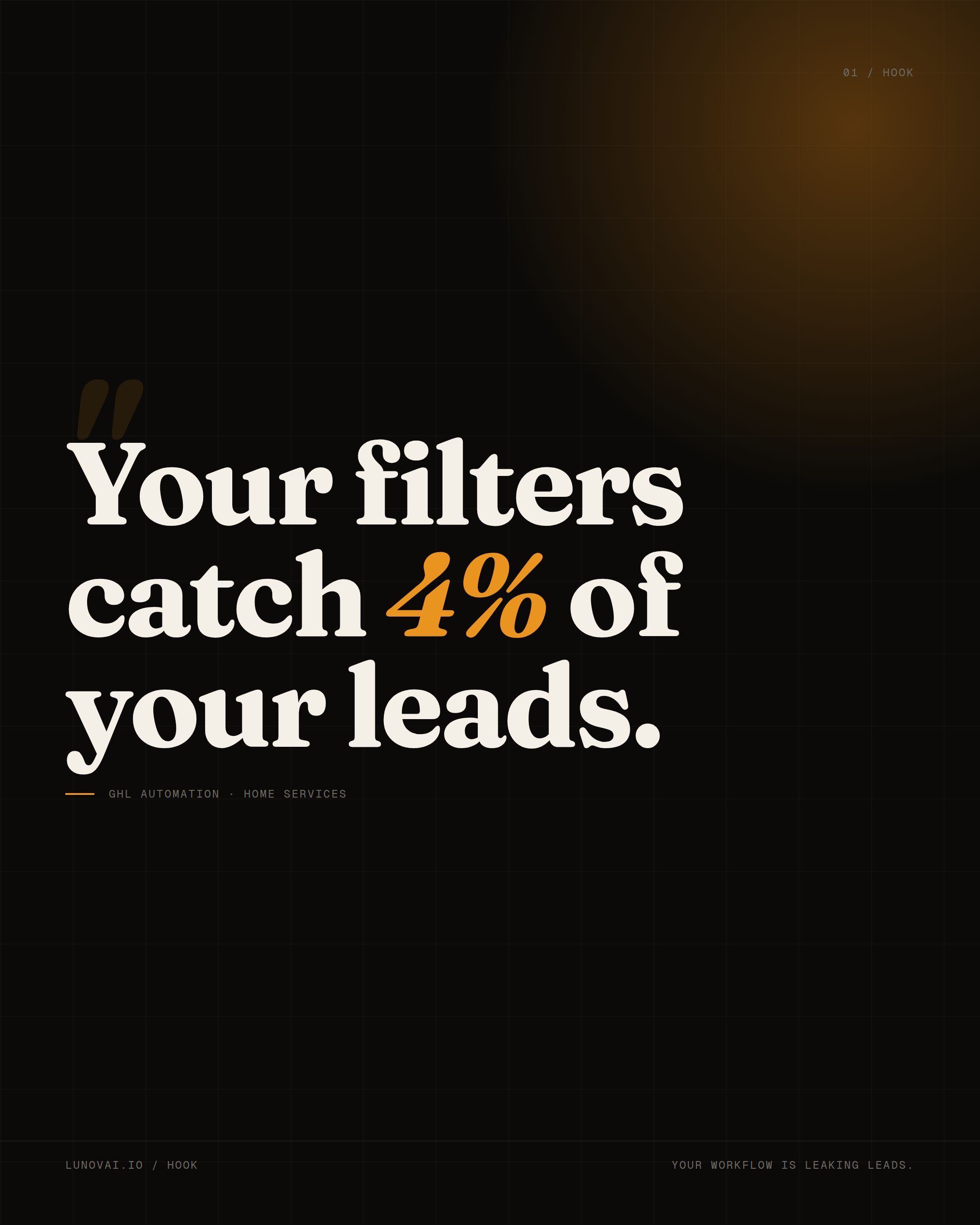
Your GHL automation isn't broken. It's just fishing with a net full of holes. Most home service businesses set up 3 trigger filters — source, status, tag — and call it a clean workflow. It feels organized. It looks clean in the pipeline view. And it's quietly ignoring 96% of the leads coming through your funnel. Here's why this happens: filters built around *how you expect leads to arrive* will miss every lead that arrives differently. A Facebook form fill with a mismatched tag. A Thumbtack inquiry that lands without a source value. A website chat widget contact that never gets a pipeline stage assigned. None of them hit your triggers. All of them go cold. The 4% that DO get caught are the clean, predictable ones — usually Google LSA or a direct form tied to a specific campaign you set up yourself. Those leads were probably going to convert anyway. Your automation is just following up on the easy ones and doing nothing for the rest. The fix isn't more filters. It's building a catch-all branch first — a workflow that grabs every new contact, regardless of source or tag completeness, and runs them through a basic qualification sequence before routing. You add specificity downstream, not at the entry point. Broad net in, sorted by behavior after. One roofing client we worked with went from 6 automated follow-up touchpoints a month to 61 — same lead volume — just by removing the source filter at the top of their main workflow and letting the system see all the contacts it had been ignoring. Booked appointments went up 34% in the first 30 days. If you're running GHL and want to see where your trigger logic is creating blind spots, send me a DM — happy to take a look at your workflow structure and tell you exactly where leads are falling out. #GoHighLevel #HomeServiceMarketing #MarketingAutomation

Most home service marketing problems aren't marketing problems. They're operational, pricing, or tracking problems wearing a marketing costume. Before touching a single ad or rewriting a single page, here are the 5 questions we ask every home service company — and what the answers actually reveal. **1. "What's your current cost per booked job?"** Ninety percent of owners don't know. That's not a judgment — it means there's no baseline. You can't improve a number you're not tracking. This question exposes whether we're starting from data or starting from scratch. **2. "Where did your last 20 customers come from?"** Not a guess. Not "mostly Google, I think." The actual source. This one question separates companies with a working acquisition channel from companies with accidental revenue. If the answer is "referrals and word of mouth," that's a ceiling, not a strategy. **3. "What happens when a lead calls and no one answers?"** For most companies: nothing. No callback system, no voicemail follow-up, no text. The average home service company misses 35–40% of inbound calls during peak hours. Pouring more money into lead gen before fixing that is filling a bucket with a hole in it. **4. "What's your average ticket, and do you know your top 3 most profitable services?"** This exposes whether marketing should be driving volume or value. An HVAC company averaging $180 service calls needs a completely different strategy than one closing $6,000 system replacements. Same ad budget, completely different playbook. **5. "If we doubled your leads tomorrow, could your operation handle it?"** This one makes people pause. Twice we've had discovery calls where the honest answer was no — not enough techs, dispatch was already overwhelmed. Scaling broken capacity doesn't grow a business, it breaks it faster. The point isn't to audit you into paralysis. It's to make sure the marketing we build actually converts into revenue — not just traffic, impressions, or leads that go nowhere. If you're not sure what your answers would be to these five, that's worth knowing before your next ad spend. DM me "5 questions" and I'll send you the full diagnostic worksheet we use with new clients — no pitch attached. #HomeServiceMarketing #LeadGeneration #ContractorMarketing
Most HVAC owners blame their ads when leads dry up. The ads are rarely the problem. Here's what's actually happening: you're paying Google or Meta to send people to an offer that doesn't give them a reason to choose you over the three other HVAC companies running the same ad. "Get a Free Quote" is not an offer. It's a form. Every competitor has one. When someone clicks yours and sees nothing different on the other side, they bounce — and you pay for that click anyway. The myth is that more ad spend fixes a lead volume problem. It doesn't. Doubling your budget on a weak offer just means you lose money faster. The businesses that crack paid ads in this industry usually aren't outspending anyone — they've just built something specific to say yes to. Think about what's actually on the table for your customer in June: their AC went out, it's 91 degrees, they have two kids at home, and they've already called two companies who said "we can get there Thursday." An offer that says "same-day diagnostic, guaranteed" with a fixed $79 fee isn't just a headline — it's the exact answer to the exact problem they have right now. That converts. If your landing page looks like your offer could belong to any HVAC company in your market, it will perform like it too. Before you touch your ad spend, fix what people land on. Tighten the offer to one urgent, specific promise. Add proof — a real number, a review that mentions a specific situation, a photo of an actual tech. The traffic isn't your problem. You have an offer problem. If you're running paid ads and your cost per booked call is above $120, drop a comment or send me a message — happy to take a look at what's going on. #HVACMarketing #HomeServiceBusiness #LeadGeneration

Most pressure washing companies have already earned their next $47K — they just never asked for it. Here's what that actually looks like: A homeowner hires you in April to clean their driveway and house exterior. Job goes well. They tip you mentally, meaning they think 'I'd use them again.' Then life happens. Twelve months pass. They hire whoever shows up first in their Google search — which is your competitor. That's not a sales problem. That's a follow-up system problem. The math is straightforward. If you've completed 200 residential jobs at an average ticket of $350, a 67% rebooking rate — which is conservative for satisfied customers — is $46,900 sitting in a spreadsheet you're not touching. That money doesn't require new leads, new ad spend, or new reviews. It requires one automated sequence. Here's what the sequence looks like inside GoHighLevel: Day 1 post-job: automated SMS — 'Thanks for trusting us with your home. Your before/after photos are attached. Reply SAVE and we'll remind you when it's time for your next clean.' Day 3: automated review request — one link, one tap. Month 11: automated re-engagement — 'Hey [First Name], it's been almost a year. Driveways in [City] are collecting a full season of grime. Want us to quote your spring clean?' — with a booking link. That's it. Three touchpoints. Built once. Runs without you. The owners who set this up in Q1 are looking at their summer calendars right now wondering why they're booked out. The ones who didn't are running ads to replace customers they already had. If you want the exact workflow template we use for pressure washing clients, send me a DM with the word FOLLOWUP and I'll send it over. #HomeServiceMarketing #PressureWashing #GHL
Scheduled posts.
He was spending $15K/month on roofing ads and closing 12% of his leads. The problem wasn't the ads. When we audited his process, every lead landed in a shared Google Sheet. Three office staff, two sales guys, all looking at the same spreadsheet. No owner. No timestamps. No follow-up sequence. Leads were sitting 3–5 days before anyone called. When they did call, it was one attempt. No text. No email. Just a note in column G that said "left VM." We rebuilt the whole thing in GHL in about two weeks. Every new lead got a text within 90 seconds, an intro email, and a follow-up sequence that ran for 14 days without anyone touching it. Sales reps only saw leads that had already responded. Close rate went from 12% to 31% in 60 days. Same ad spend. Same market. Same crew. The leads were never the issue — they were just dying in a spreadsheet. If your team is still working leads manually, you're not running a follow-up system. You're hoping. 📋 DM us "FOLLOW-UP" and we'll show you exactly how this sequence is built. #roofingbusiness #roofingcontractor #homeservicemarketing #roofingleads #gohighlevel #crmautomation #leadfollowup #roofingcompany #contractormarketing #smallbusinessgrowth #homeservicebusiness #digitalmarketingforhomeservices #roofingmarketing #automationforcontractors #contractorgrowth
Every missed call you don't follow up on is a booked job you gave to your competitor. 📞 "If they really want it, they'll call back" is the most expensive belief in the home service industry. It sounds logical. It's not. Studies put the average close rate on a called-back lead at 30–40%. That drops to under 5% if you wait more than an hour. Most businesses don't call back within a day. The customer already booked someone else — someone who picked up or texted back in 10 minutes. Here's the real math: if your average job is $850 and you're missing 3–4 calls a week without follow-up, you're walking away from $130,000–$175,000 a year. Not because your pricing is wrong. Not because your reviews are bad. Because you assumed they'd come back. They won't. Not when the next HVAC company, plumber, or roofer on Google is one tap away. Set up a simple missed-call text-back — even a basic one that says "Hey, we missed you. We're booking now, reply here or call us back." That one move alone recovers a significant chunk of those lost jobs. Check your missed calls from the last 30 days. Count them. Do the math yourself. #HomeServiceMarketing #HVACBusiness #PlumbingBusiness #RoofingContractor #LeadGeneration #MissedCalls #HomeServiceBusiness #ContractorMarketing #SmallBusinessGrowth #ServiceBusiness #DigitalMarketing #ContractorLife #LocalBusiness #HomeServices #LeadFollowUp
A homeowner's AC died at 2pm on a Friday. She called three HVAC companies. 📞 You were on a job. You silenced it. You told yourself you'd call back after 5. Company #2 picked up on the second ring. Booked her for a same-day diagnostic at $89. Found a failed capacitor and a refrigerant issue. Total ticket: $847. You called her at 6:47pm. She was already cooling down. This isn't bad luck. This is a system problem. Most home service owners treat missed calls like minor inconveniences. They're not. They're closed deals walking to your competitor — because the homeowner in an emergency will hire the first person who answers, not the best person who calls back. The fix isn't complicated. An answering service runs $200–$400/month. An AI receptionist costs less. Even a trained office admin changes everything. Any of those options would have kept that $847 in your pocket — and probably turned her into a maintenance contract customer worth $300/year after that. One missed call isn't a big deal. Missing 3–5 a week is $150K a year leaving through your voicemail. Audit your missed calls from last month. Just look at the number. Then decide if the fix is worth it. #HVACBusiness #PlumbingBusiness #HomeServiceMarketing #LeadGeneration #SmallBusinessGrowth #ContractorLife #ServiceBusiness #MissedCalls #HomeServiceBusiness #BusinessGrowth #ContractorMarketing #HVACMarketing #RunYourBusiness
Your GHL workflow looks fine — but it's quietly dropping leads. 🔥 Most broken automations don't throw errors. They just stop firing. And by the time you notice, you've already lost 10, 20, maybe 40 leads to silence. Here are the 5 things that kill workflows without warning: 1. Trigger filters set too narrow — your lead comes in, nothing matches, workflow never starts 2. Dead calendar links inside appointment booking steps — nobody gets scheduled, nobody follows up 3. Email sender reputation flagged — your follow-up sequence is "sending" straight to spam 4. Wait steps stacked on top of each other — a 1-hour delay became a 72-hour delay after one edit 5. A disconnected integration (Facebook Lead Ads, Zapier, your website form) that stopped syncing weeks ago The 2-minute check that catches all of this: Go to GHL → Reporting → Workflow Results. Filter by your highest-volume workflows. Look at the "Enrolled" column vs. the "Completed" column. If there's a gap bigger than 20%, something is leaking. Then open the workflow, hit "History," and look at where contacts are stopping. That's your break point. Fix it there. Do this every Monday before you spend a dollar on ads. A broken follow-up workflow makes every lead you buy worthless. Want the full workflow audit checklist? Link in bio. #GoHighLevel #GHLautomation #HomeServiceMarketing #HVACMarketing #PlumbingBusiness #RoofingMarketing #MarketingAutomation #LeadFollowUp #HomeServiceBusiness #CRMtips #WorkflowAutomation #SmallBusinessMarketing #ContractorMarketing #ServiceBusinessGrowth

A $5K GoHighLevel build isn't a fancy template. Here's what you're actually paying for. Most GHL setups sold to home service businesses are templates with your logo slapped on. Same pipeline stages. Same generic nurture emails. Same "missed call text back" and nothing else. You could buy that for $97. A real $5K build starts with your actual business — how leads come in, where they go silent, which jobs have the highest close rate, and what your CSR says on the phone. That audit alone takes days. Then you're building custom pipelines per lead source (LSA, Google Ads, and referrals don't behave the same way). Automations that route by zip code, job type, or time of day. Review request sequences timed to when your customers are actually happy — not 10 minutes after the invoice. You're also paying for the integrations. Zapier bridges to your field software. Calendar logic that blocks techs correctly. Forms that pre-qualify before a human touches anything. And the month after launch? That's where the real work happens — watching the data, fixing the drop-offs, and making it actually run without you. Templates give you a system that looks like it works. A real build gives you one that does. 🔧 Want to see what a proper GHL audit looks like before you spend a dollar? Link in bio. #GoHighLevel #GHLautomation #HomeServiceMarketing #HVACMarketing #PlumbingBusiness #RoofingMarketing #ElectricalContractor #LandscapingBusiness #MarketingAutomation #CRMsetup #HomeServiceBusiness #SmallBusinessMarketing #ContractorMarketing #LeadNurturing #ServiceBusinessGrowth
Your ads aren't broken. Your response time is. ⏱️ Most home service owners blame their campaigns the second leads go cold. Wrong diagnosis. Studies show 78% of customers hire whoever responds first — and the average contractor takes 47 hours to follow up. The lead wasn't bad. You just let a competitor answer faster. Here's the automation stack that fixes it: 1. Missed call text-back — fires within 30 seconds of a missed call, keeps the lead warm while you're on a job 2. CRM auto-assign — new form fills or calls get routed to a real person immediately, no leads sitting in a shared inbox 3. Two-touch email + SMS sequence — sends within the first 5 minutes, then again at the 1-hour mark if no reply 4. Review request trigger — fires automatically 24 hours after job completion, so your reputation builds without you thinking about it None of this requires a full-time person. It requires a one-time setup — most of it inside a single tool like GoHighLevel or HubSpot. Before you pause your next campaign, check your average response time. That number will tell you everything. Want the exact workflow mapped out? Link in bio to grab the free response automation guide. #homeservicemarketing #leadgeneration #hvacmarketing #plumbingbusiness #roofingcontractor #contractorlife #smallbusinessmarketing #digitalmarketing #homeservicebusiness #marketingautomation #contractormarketing #followupfast #landscapingbusiness #pestcontrolmarketing #electricianmarketing

Your GHL workflow isn't broken. Your test contact is. 🔍 After auditing 50+ home service accounts, the same problem shows up over and over — and it's not the logic. The triggers are right. The branches make sense. But the workflow still misfires. Here's why: most owners test with a contact that's been used a dozen times before. Old tags still on it. A pipeline stage that doesn't match. A phone number that's already received the message. GHL sees that contact and behaves differently than it will for a real lead. So the test "passes" — and the first real customer gets a follow-up text for a job they never booked, or radio silence after filling out your form. Clean test data isn't a small detail. It's the difference between a workflow that works in practice and one that only works in demos. Before you go live on any automation: create a fresh contact, clear tags, no history, correct pipeline stage. Run it like a real lead would hit it. That's the only test that counts. Want a checklist for how we prep test contacts before every GHL build? DM us "TEST" and we'll send it over. #GoHighLevel #GHLAutomation #HomeServiceMarketing #HVACMarketing #PlumbingBusiness #RoofingMarketing #ElectricalContractor #LandscapingBusiness #MarketingAutomation #CRMAutomation #HomeServiceBusiness #SmallBusinessMarketing #AutomationTips #WorkflowAutomation #ContractorMarketing